

SolveForce Releases April 2026 Telecom Market Update: Lower Prices, More Fiber
Telecom Analysis Reveals Lower Introductory Broadband Prices, Wider Fiber Access, and Smarter Bundling Strategies for Homes and Businesses in 2026
Yorba Linda, CA, April 24, 2026 (GLOBE NEWSWIRE) -- SolveForce today released its April 2026 Telecom Market Update to help residential and business users navigate competitive broadband pricing, expanding fiber availability, and evolving connectivity options. Amid rising scrutiny of monthly bills and strong demand for reliable upgrades, intensified competition is lowering introductory prices while increasing access to high-speed fiber, though choices among cable, fiber, and satellite providers can still feel complex.

SolveForce.com | Competitive Broadband and Fiber Solutions for Homes and Businesses
Residential Broadband Trends
Internet remains the essential centerpiece of modern households, with providers competing aggressively on speed and affordability. Entry-level plans delivering 300 Mbps — more than enough for everyday browsing, multiple devices, and light streaming — are available in many markets starting as low as $25–$35 per month, often with multi-year price locks in select areas. Speeds scale quickly to 500 Mbps around $35–$50 and gigabit (1 Gbps) service near $50–$70 with attractive introductory offers.
Symmetric upload and download speeds are rapidly becoming standard in fiber-served neighborhoods, enabling seamless video calls, 4K/8K streaming, and remote work. In rural or underserved areas, satellite services offer accessible promotional pricing for the first few months before transitioning to standard tiered rates.
On the high end, multi-gigabit speeds (2–8 Gbps) are available in select markets, typically ranging from $90–$250 per month. These ultra-fast connections support households with heavy 4K/8K streaming, online gaming, and multiple remote workers.
Bundling continues to deliver meaningful savings. Triple-play packages combining high-speed internet, TV, and home phone service often start as low as $110 per month with promotional pricing, including hundreds of live channels and unlimited nationwide calling. Modern TV service blends traditional channels with flexible streaming integration through provider apps on smart TVs or optional streaming devices. Adding a reliable VoIP home phone line typically costs an extra $10–$20 per month.
Many providers waive installation fees with free self-install kits, though professional setup can reach $99 and is frequently waived during promotions. Equipment rental generally adds $10–$15 per month (with many fiber plans now including it at no charge), while taxes and regulatory fees increase the final bill.
Consumers should compare options at their specific address, inquire about current price locks or guarantees, and carefully review all terms, including autopay and paperless billing requirements. Promotional rates are for new customers, subject to change, with availability varying by location.
Business Connectivity Solutions
For commercial users, priorities center on guaranteed performance and uptime. Businesses increasingly seek symmetric fiber connections backed by strong service-level agreements (SLAs) targeting 99.5%+ availability and rapid response times.
Entry-level business fiber has grown more accessible, with symmetric plans starting in the $60+ range when bundled, while standalone pricing is typically higher. No-contract flexibility is available in many markets, and gigabit to multi-gig plans (1–5 Gbps) generally range from $90–$350 per month — more affordable than in prior years.
Dedicated Internet Access (DIA) with uncontended 1 Gbps connections remains the premium choice for mission-critical operations, typically priced $400–$1,000+ per month depending on the region, with robust SLAs and static IPs. Many providers now combine primary fiber with wireless backup for seamless failover.
Key trends include network convergence to eliminate single points of failure, rapid nationwide fiber expansion, growing adoption of no-contract options and multi-year price guarantees, AI-enhanced proactive monitoring, sustainability initiatives, and edge computing for latency-sensitive applications.
“The best telecom decision is an informed one. Visit SolveForce’s Fiber Internet Lookup Tool today to instantly compare the latest business fiber plans available at your exact address. Or call our team at 888-765-8301 and speak directly with a live agent who can provide unbiased recommendations tailored to your needs—whether you’re a homeowner seeking reliable gigabit speeds or a business requiring enterprise-grade connectivity with strong SLAs.” — Ron Legarski, Principal at SolveForce
Looking Ahead: 2026–2030 Outlook for Consumer and Business Telecom
The U.S. consumer and business telecom sector is expected to evolve steadily through 2030, driven by expanding fiber deployments, rising demand for symmetrical multi-gigabit speeds, and greater network convergence.
For residential consumers, fiber-to-the-home (FTTH) penetration is projected to grow significantly, positioning fiber as the dominant fixed broadband technology in most markets by decade’s end. Multi-gigabit symmetrical plans (2 Gbps and higher) will become more available and affordable due to competition and infrastructure investments. Fixed wireless access (FWA) and satellite services will complement fiber in rural areas, enabling flexible bundles with mobile and streaming services. Consumers needing strong upload speeds for remote work and multi-device homes will benefit most from symmetrical fiber options.
For businesses, demand for reliable, low-latency connectivity will rise with cloud adoption, AI applications, and hybrid work. Symmetrical multi-gigabit fiber paired with SD-WAN, SASE security, and strong SLAs will become standard. Network convergence will improve resilience, while edge computing opens opportunities in key industries. Businesses should prioritize total cost of ownership, uptime, and scalability when selecting providers.
Overall, the U.S. broadband services market is projected to grow at a compound annual growth rate of approximately 7.9% in the United States from 2026 to 2033. This will be supported by data-intensive applications and infrastructure modernization. Competition may moderate urban pricing, but availability, reliability, and bundled value will remain key differentiators.
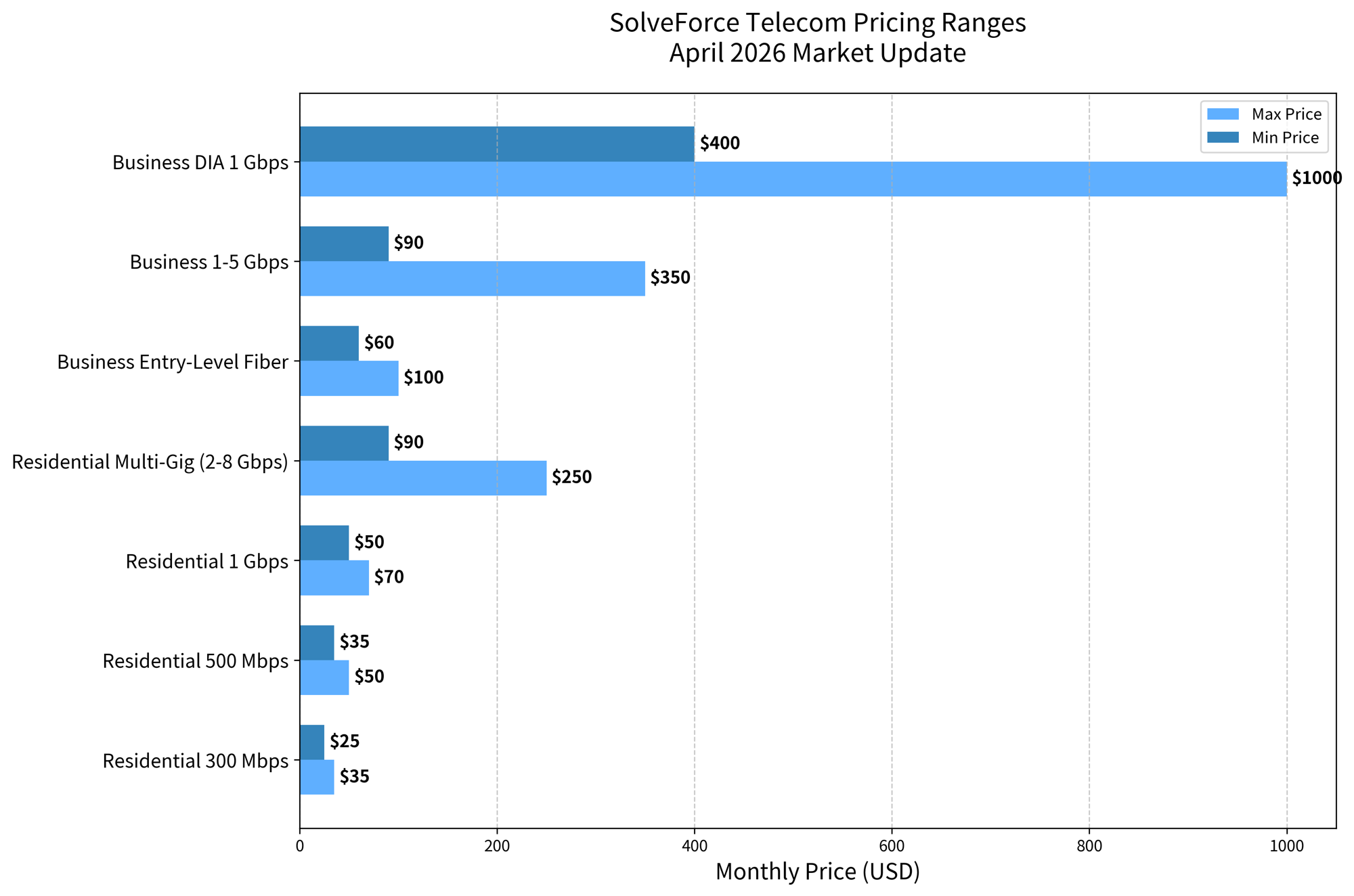
Telecom Pricing Ranges April 2026 Market Update
About SolveForce
SolveForce is a telecom consulting and brokerage firm with over 20 years of experience. The company connects businesses and residences across the U.S. and internationally with high-performance internet, voice, cloud, cybersecurity, networks, data centers, and AI-driven solutions. SolveForce acts as a single point of contact to simplify complex telecom decisions and deliver tailored connectivity that supports today’s digital demands. For a free personalized consultation, visit SolveForce.com or call 888-765-8301.
Press Inquiries
Media Contact:
Steve Sramek
Email: steve@solveforce.com
Phone: 408-673-9943


Legal Disclaimer:
EIN Presswire provides this news content "as is" without warranty of any kind. We do not accept any responsibility or liability for the accuracy, content, images, videos, licenses, completeness, legality, or reliability of the information contained in this article. If you have any complaints or copyright issues related to this article, kindly contact the author above.
